Sunday, 15 June 2014

Glance Turns Almost Any Wrist Gear Into a Smart Device

It's not a smartwatch, but it's pretty dang close.

Glance is a wristband prototype accessory that can effectively turn a regular watch into a smartwatch. Designed by Kiwi Wearables, a startup based out of Toronto, Canada, Glance can be tucked in behind a regular watch band and synced with a smartphone.

The device can alert the wearer to incoming calls or text messages, track movement and be used as a remote control for a smart TV, according to the device's Kickstarter page.

Unlike many smartphones, which can only survive a few hours of optimum use before needing juice, Glance's designers created it to last for a week without charging. When its power is low, the Glance's battery can easily be recharged via its USB port, just like any other mobile device.

Glance also uses a 3D motion detector to measure movement. For example, it can tell how many steps you've taken or how many miles you've biked. It also has the added benefit of being waterproof.

The team behind Glance is looking to raise $150,000 by July 3 to fund the project. So far, they have nearly 500 contributors who have collectively put up just over $41,000.

Read full Article…

Thursday, 22 May 2014

Waterproof 360-Degree HD Camera Adds a World of Depth to Oculus Rift


With tools such as the Facebook-owned Oculus Rift moving into the mainstream, panoramic video and imagery are increasingly becoming necessary perspectives rather than mere visual curios.

Helping to meet that need is a new Kickstarter-backed panoramic video camera called the 360cam.

Created by France-based Giroptic, the tiny device might remind you of the roof-mounted camera seen on Google Street View cars. But this isn't a tool for large corporations; it's designed for the average user.

Housed in a blue and black plastic egg-like shell, the device allows you to capture 360-degree HD video and photos, all while delivering the device's current status on its surface via LED display. The display can indicate the camera's current mode (Time Lapse, Burst, Photo, Video, Live) and count down during timed photos.

Oculus owners can view live panoramic video through the 360cam's Oculus Rift video player. And, because the 360cam is waterproof, it offers the potential of virtual trips under the surface, for the first time. To enhance the visual clarity of underwater shots, the device also comes with a unique set of goggles for its lenses.


A few weeks ago, we saw a similar device called the Centr Cam, developed by a team of former Apple employees. But at time of writing, with only eight days to go, that Kickstarter campaign has raised roughly $500,000 of its $900,000. By contrast, the 360cam quickly blew past its goal of $150,000 — earning nearly $180,000 with 43 days of crowdfunding left.

"We have a wider field of view, 360x150 vertical, covering almost the full sphere, [and] we have a gyroscope for image stabilization," a Giroptic spokesperson told when asked to list differences between the two products.

Early backers of the device will receive the 360cam in August, and the company expects to start selling the camera in November for about $499.

Image: GIROPTIC

Read full Article…

Tuesday, 13 May 2014

This Smart Lighter Will Help You Quit Smoking


A new Internet-connected lighter called Quitbit will light your cigarette, but wean you off a smoking habit too.

A new Kickstarter campaign called Quitbit takes the same monitoring principles embedded into fitness trackers and helps users track and cutdown on smoking. In a nod to the name, it's like a Fitbit for smoking.

The product, which launched on Monday and is seeking $50,000 in funding pledges, is a pocket lighter that uses a heating coil similar to what's found in cars. But whether you're looking to quit or not, the lighter keeps track of every time you light up and logs that data in an accompanying app.

Users can set custom plans — so they can trim on intake at whatever pace they want — and see much money they've saved by cutting back on packs along the way. It also reveals the time since your last smoke, how many were consumed within a certain period of time and lets you call out the times you shared a cigarette with a friend (or let someone borrow the lighter).

The Quitbit, which also works with e-cigarettes or the patch, was developed by two friends who wanted an easy way to track the quitting process.

"Kuji and I were both smokers and met while in grad school together at Brown," co-founder Ata Ghofrani told. "I was trying to quit when he asked how much I smoked, and I realized there wasn't a really good way to keep track." "I was trying to quit when he asked how much I smoked, and I realized there wasn't a really good way to keep track."

Although there are countless apps on the market that help smokers quit, this is the first solution that includes hardware: "We wanted a piece of hardware to automatically monitor how much you're smoking, without having to manually enter that information within the app," he added.

Although it's up to each person to decide when and if they want to quit smoking, keeping the Quitbit in your pocket — we assume — gives the same affect of wearing a fitness wristband tracker. Sure, you might not wear a Fitbit to specifically lose weight, but it serves as a constant reminder to stay active.

The Quitbit will likely do the same; having access to all of your smoking data might the final nudge you need to scale back.

IMAGE: QUITBIT

Read full Article…

Thursday, 8 May 2014

Pocket-Sized Charger Claims to Keep Your Devices Juiced Up


Low battery, you may have met your match.

A new portable charging system aims to put on-the-go power in your pocket, boasting a set-up that reportedly doesn't compromise on power or portability. Modulo, developed by Barcelona-based tech company Idapt, is a credit card-sized gadget that claims to power any USB device, wherever you go.

"All our lifestyle now goes to electronics — it's portable, really portable," Idapt CEO Jacques Giribet told. "We have designed a battery that is as small as possible, taking into account that we want it to give you the same power as the original battery."

Once an electronic device is connected to a Modulo, either with its original charger or one of Idapt's mini cables, the battery begins to power up. The two can be even more securely attached with special adhesive strips that don't leave any residue behind. Stacking multiple Modulos on top of one another means more juice for a faster charge. For example, one Modulo would be enough to power up a smartphone as quickly as a normal charger would, but a tablet would need two or three to reach a full charge in the fastest possible time, the company claims.

The Modulos themselves can be charged from any wall socket, while connected to a computer or with a wireless receiver. Idapt also hopes it will be able to offer a solar-charging panel and crank add-on that creates its own energy. A Modulo can last up to about six months on one charge, according to the company.

There are plenty of other on-the-go charging options out there. According to Giribet, what sets Modulo apart from the rest of the pack is the fact that it's compatible with so many devices, and users don't have to choose between true portability — each Modulo weighs 2.4 ounces — and function.

"None of the solutions that are there are really a solution," Giribet said.

Modulo's Kickstarter campaign has already surpassed its fundraising goal, attracting more than $60,000 out of its original $30,000 goal, with 24 days remaining. It also won iLounge's Best in Show award at CES 2014. Production is expected to begin June, and shipping will start in July.

Image: IDAPT

Read full Article…

Sunday, 4 May 2014

Capture 360-Degree HD Video With This Tiny UFO-Style Camera


Tools like Google Street View and even Apple's iPhone allow you to view the world as captured in panoramic photos, but a new camera called Centr delivers the same kind of immersive experience in high-definition video.

Created by a team of ex-Apple employees, Centr is a beautifully designed, palm-sized panoramic camera that you can control with your smartphone or tablet (iOS and Android).

"Think of it as a GoPro plus," Centr CEO Bill Banta told. "It lets you do everything you could with a GoPro, plus see another dimension.It allows the user to get perspectives that they couldn't normally get with a GoPro. Now you have the opportunity to create a panoramic selfie."

Giving users the ability to record 360-degree high-definition video is something the team has been working on for several years. Working under the name Stealth HD, the team provided private panoramic video recording solutions for the military, sports organizations and companies like Red Bull and National Geographic.

But it was only within the last 12 months that the team reached a point where they believed the technology could be made available to the general public at an affordable price ($399 at retail, with lower prices available now during pre-order).

"Our dream has always been to bring this type of tech to the mass market," says Banta. "We had a real breakthrough last year. We got to a point where we were able to do all the calibration and processing in real-time."

Using in-camera calibration, Centr's four independent HD image sensors stitch together panoramic videos in real-time, delivering an entirely different, and often quite revealing perspective on reality.

"The real value is you don't have to worry about anything being out of frame or out of focus," says Banta.

With up to two hours of battery life for continuous shooting (six hours standby), the device, which can be held through its center hole, or using a tripod, immediately opens up the possibility of innovative filmmaking using Centr's 360-perspective.

"The longest we've recorded is a full day at Burning Man," says Banta. "If you have a 64GB SD card, you should be able to get 7 to 8 hours of recording time, assuming you're recording at 720 resolution."


The camera can also shoot 1080p video and is equipped with 8GB of flash storage, three microphones, built-in Wi-Fi and Bluetooth capability and a USB 3.0 connector.

Once they decided to release the product commercially, the team turned to Kickstarter, a route startups are increasingly relying upon to test out market demand. In this case, the makers of Centr are looking to raise $900,000 from early backers, a pretty ambitious goal for a product that is likely to appeal to a small niche of users.


"For people that just take pictures, it's probably not the perfect product," says Banta. "It's for people who love video and who love capturing memories and experiences through video."

Another factor that may bolster the project's success is the fact that the product's DNA is infused with Apple tradition and attention to detail. Banta managed Apple's supply chain for its camera group for four years, and Centr CTO, Paul Alioshin, led camera engineering at Apple and was part of the team that brought the built-in iSight camera to the Mac, MacBook and iPhone.

As of this writing, the project has garnered nearly $300,000, with 25 days to go, so that nearly $1 million goal may not be as lofty as some might think.


Image: CENTR CAMERA

Read full Article…

Tuesday, 29 April 2014

FretPen Is the Tiniest Guitar You Will Ever Play


The urge to RAWK OUT really can hit at any time or place, but who wants to be that weirdo who's always lugging a guitar around?

Now there's FretPen, which makes even your hipster ukelele look big and clumsy.

Pop off the cap, snap the ball-point end into the guitar body and pluck the tiny string; a Bluetooth-connected smartphone acts as a wireless amp that can make a host of sounds, from clean acoustic to dirty garage.
Since there’s only one actual string, you also need to play a directional pad on the body to move across the strings, which isn’t all that hard for a seasoned player. Though FretPen is too small to create actual string vibrations — electronics in the fretboard recognize your finger positions instead — its external materials are just like a real electric guitar. The fretboard is wood, the frets are steel and the string is also the real deal:

(And yes, it’s actually a functional pen, so you can jot down those epic lyrics you channeled from the cosmos during that face-melting riff.)

You can’t buy the FretPen just yet; the Colorado-based makers just launched a campaign Monday on Kickstarter. But you can pre-order it there, with delivery expected sometime in November — just in time for your huge tour (of the waiting area at the airport gate during holiday travel).

IMAGE: FRETPEN FRETPEN

Read full Article…

Tuesday, 25 March 2014

LG's Smart Bulb Connects With Your Smartphone


LG has launched the Smart Bulb in Korea, a light bulb that connects with Android and iOS devices, providing several interesting features.

The 10W LED bulb will let you control lighting in the house with a smartphone, and it can also flash-alert when you get a phone call.

Other features include a security mode which makes it look like you're at home when you're away, as well as pulsating to the tune of music (but only on Android devices).

The bulbs should run for more than 10 years, provided you use them five hours a day, LG claims.

LG's Smart Bulb is not the only connected light bulb around. Recently, a company called AwoX announced a light bulb that can double as a Bluetooth speaker. We've also seen several Kickstarter projects to create a connected light bulb; the Wi-Fi enabled LIFX is one example.

The price for the LG Smart Bulb is 35,000 won ($32) in Korea; there's no word when the device might come to the U.S.

IMAGE: LG.COM

Read full Article…

Tuesday, 11 March 2014

Neil Young Turns to Kickstarter for His High-Res Music Player


For most, the digital music on our iPhones and streaming services like Spotify and Pandora sounds just fine.

However, to a small-but-vocal group of audiophiles, it sounds like crap. Even as digital music downloads have increased in quality (iTunes used to sell mostly 128kbps downloads; now they're 256kbps), the music is still compressed. Some people say they can hear the difference.

Neil Young is one. He's been trying to get his Pono music player off the ground since at least 2012, and now he's taking another stab via Kickstarter. The PonoMusic player is a triangular iPod-like device designed specifically for high-quality audio.

How high? The Pono can play music in the FLAC (Free Lossless Audio Codec) format up to 9,216 kbps or 192kHz/24-bit recordings. For the record, that's technically far above what's generally regarded as the limits of human hearing, which maxes out at about 20kHz. Acoustic physics dictates that the sampling rate should be at least double the maximum frequency you need to produce, which is why CDs — indeed, most consumer audio formats — use 44.1kHz as a sampling rate.

That's not good enough for Young, and he's been clear on that for years. He was a proponent of the doomed DVD-Audio format in the early 2000s, but now he and others are trying to bring the vision of portable high-res audio to live through crowdfunding.

With 34 days to go, the PonoPlayer is more than halfway to its goal of $800,000 to bring the product to market.

That's even more impressive considering audiophiles already have options if they want to listen to portable high-res audio. Astell & Kern offers a high-resolution portable music player through the iriver brand as well as digital-to-audio converters for listening to better-quality music on an iPhone or Android device. Some apps, such as FLAC Player+ and OraStream, provide users options for high-res audio, too. And sites like HD Tracks offer many high-quality tracks users can import into their music libraries.

Still, the PonoPlayer would add another option to the mix, and the plan is to answer a key question about high-res audio: where to get the music. Pono plans to open a music store when they release the player, letting users download tracks and transfer them to the player via USB — functionally identical to iTunes/iPod, but a little anachronistic in 2014.

Most audiophiles would probably think it's worth the trouble, though. The target $399 retail price is a little on the high side, but interested backers of the project can reserve one now for just $200. Considering the speed at which the Pono project is attracting donations, there's a lot of them out there.

Image: KICKSTARTER

Read full Article…

Tuesday, 4 March 2014

This Bluetooth Ring Is Like a Magic Wand on Your Finger


We've seen interactive rings that receive alerts from your smartphone and even rings that will give you the current time in a unique way, but a new ring leapfrogs the rest by acting as a full-on control mechanism.

On its exterior, Logbar's Ring device looks like nothing more than a silver ring, but packed inside the device are electronics that allow it to recognize your finger gestures and control any number of devices.

Logbar CEO Takuro Yoshida gave a detailed demonstration of the silver interactive device last year in San Francisco, and now Ring is available for purchase through a Kickstarter campaign.

By recognizing finger gestures, Ring allows the wearer to write text messages by simply drawing in the air. The same dynamic allows the wearer to access apps by drawing designated shapes in the air. For example, drawing a music note could access your music player, while drawing an envelope shape would allow you to access your email.

More advanced functions depicted in the company's Kickstarter video (see above) include using the Bluetooth device for mobile payments via GPS or iBeacon, and as a controller for televisions and lights in smart homes. The company also says that it has tested Ring with devices spanning a wide spectrum of currently available, bleeding-edge hardware, including the Pebble watch, quadcopter drones and even Google Glass.

Ring's associated app also allows you to program original shape gesture commands. This option could be particularly useful for disabled or visually impaired users with somewhat unconventional finger gesture patterns.

To activate the device, you simply press the side button on the Ring, and to receive alerts you can either receive a vibration or view the discreet little LED pinpoints near the button port. According to the device's developers, Ring can perform up to 1,000 gestures before its battery needs to be recharged.

The only obvious shortcoming of the device at this point is that fact that it's not waterproof. That could turn into a problem for those attempting to use Ring in mobile environments during bad weather, or even inside the home, say, if you forget you have Ring on when you go to wash your hands.

Also, Ring's rechargeable battery is not replaceable. Once it stops charging, the fun is over, and you'll have to pony up for a brand new Ring. That might not be as bad as it sounds. The cheapest early bird version of the device sold for $145, and during Yoshida's presentation last year he mentioned hopes of getting the device down to the $100 range.

At launch, the Ring app will only be available for iOS and Android devices, but the company has plans to release a Windows Phone version.

The device blew past its original Kickstarter goal of $250,000 in just its first five days of availability and, as of this writing, Ring had reached about $400,000 in funding, with nearly a full month left for new signups.

Image: LOGBAR

Read full Article…

Sunday, 2 March 2014

Make Sweet Music With Any Object Using This Sensor


If you’re prone to drumming on your steering wheel, desk or whatever is in reach when listening to your jam, this device could up your percussive game.

To make a musical instrument out of the mundane, users attach the circular sensor at the end of the stethoscope-like device to the surface of any everyday object and it becomes imbued the power of music. Then, users plug Mogees into a mobile device's headphone jack and connect their headphones to the gadget to listen to the music they create.

Mogees works by employing a small, specialized sensor called a "piezo-transducer" that converts a vibration produced by tapping any physical object into an electric signal. That signal is then sent to a mobile device running the Mogees app (available for both iOS and Android) which turns the signal into music.

Users can select different options that will determine how a particular object sounds once the vibrations are converted. They can also switch between free mode — where the user can change scales and keys and improvise pieces of music — and song mode, which lets the user tap along with their favorite songs.

Bruno Zamborlin, a musician who performs with British experimental dance group Plaid, designed and created Mogees to provide a fun, plug-and-play experience, but also as a tool for music education.

"I have done several workshops in primary schools in the UK, using Mogees to teach key aspects of sound and music in the national curriculum, and the results have been terrific," Zamborlin said. "Kids really learned concepts about vibrations and acoustic properties of materials in a brand new, interactive and natural way. Mogees is not just an instrument for musicians — it's a tool for music discovery that everyone should have fun in using."

Zamborlin started Mogees’ Kickstarter campaign on Feb. 17, and has raised almost $20,000 of its $83,000 goal with 22 days left.

IMAGE: MOGEES

Read full Article…

Monday, 24 February 2014

'Minority Report' Interface, the Home Version


When Minority Report came to theaters in 2002, its futuristic technology looked generations away. Moving screens and multiple apps interacting together all were at a flick of Tom Cruise's finger. That kind of technology could be real in June.

The Swiss-based software company Dizmo surpassed its fundraising goal of $25,000 today on Kickstarter, and its savvy user interface could be available by June. Dizmo's user interface allows customers to move, swivel, shrink and expand any app, including calendars, maps, spreadsheets or videos on televisions, tablets and glass surfaces. All the features of Dizmo's interface are responsive, meaning the visual elements automatically adjust to the size they're expanded or shrunk to.

"In short, Dizmo is taking the ability to interact with your digital life to the next level," Matthias Aebi, Dizmo's co-founder and CEO, said in a video on Kickstarter. Aebi did not mention how much the software will end up costing.

The potential of Dizmo — a combination of "digital gizmo" — is portrayed in the "Day of Glass," video by Corning, maker of Gorilla Glass. Almost every glass surface in the video has interface technology — the kitchen counter, the fridge, the bathroom mirror and more. The vision is obvious: a touchscreen on any and every surface in your home.

Dizmo launched its fundraising campaign on Feb. 6, completing its monetary goal in under two weeks. So far almost 300 have people donated to Dizmo, according to Kickstarter. The project's managers promise they'll be the first to receive the company' software.

Image: Kickstarter

Read full Article…

Saturday, 15 February 2014

Kickstarter: We Were Hacked, User Information Exposed


Kickstarter, a leading crowdfunding site, revealed it was hacked last week. In a blog post published Saturday, Kickstarter said law-enforcement officials contacted the company Wednesday night, and alerted it to unauthorized access by hackers.

No credit-card data was stolen, but hackers did manage to access some user information, Kickstarter CEO Yancey Strickler wrote in the post.

"Accessed information included usernames, email addresses, mailing addresses, phone numbers and encrypted passwords," he wrote. "Actual passwords were not revealed, however it is possible for a malicious person with enough computing power to guess and crack an encrypted password, particularly a weak or obvious one."

Following the breach, Kickstarter is recommending that all users change their passwords.

In response to the hack, Strickler said Kickstarter has already taken steps to improve its security, and is currently "working closely with law enforcement" to prevent a similar incident in the future.

And while Kickstarter has certainly garnered good will with users over the years, some may question why the crowdfunding site waited nearly four days before informing them about the hack, and instructing them to change their password information.

"For everyone’s security, we wanted to be sure the breach was fully secured before notifying all of our customers," according to a company message.

A Kickstarter spokesperson did not immediately respond to a request for comment.

IMAGE: KICKSTARTER/FACEBOOK

Read full Article…

Wednesday, 12 February 2014

A Liquid That Makes Any Pair of Gloves Touchscreen-Friendly


Touchscreen gloves are an essential accessory for smartphone addicts battling the winter chill, but the options for consumers are fairly limited. Purchasing a pair of attractive, touchscreen-compatible mittens usually means paying a pretty penny or sacrificing aesthetics for something a little easier on the wallet.

Nanotips, which is currently funding on Kickstarter, proposes a third solution: Use a conductive, polyamide liquid solution to add touchscreen capabilities to any pair of gloves.

The project has received an enthusiastic Kickstarter backing, racking up more than five times its funding goal of $10,000 CAD, or roughly $9,070.

The solution uses conductive nanoparticles to mimic the electrical conductivity of human skin, just like a normal touchscreen glove. Creator Tony Yu claims the solution will work on any material, from pricey leather to canvas gloves, for construction, golfing, cycling, skiing and snowboarding.

Yu hit upon the idea after purchasing an expensive pair of motorcycle gloves without touchscreen capabilities. Rather than buy a new pair — "touchscreen leathers are expensive and they wear down really quickly," Yu says — he searched for a solution that would integrate with his current gear.

The resulting conductive liquid is applied to the gloves' thumbs and forefingers by swiping an applicator, not unlike applying nail polish. As it dries it soaks into the fabric or forms a conductive film on each fingertip, depending on the material.

"It wasn't so hard to get a product that would interact with a touchscreen device," Yu says. "The hardest part was making it last long enough."

The Kickstarter campaign offers two separate touchscreen solutions, Nanotips Blue and Nanotips Black. The Blue solution covers standard fabrics, such as knits, while the more durable Black treats leathers, rubbers and other thick materials. Each solution leaves behind a slight color residue, however. Blue dries to a translucent blue, while the more versatile Black is, well, black. Yu is still experimenting with creating a fully transparent solution. He also warns the Black solution may alter the texture of certain fabrics.

At $22 CAD (or $20) for a single bottle, the solution is fairly inexpensive, although consumers can purchase actual touchscreen gloves for roughly the same price. The solution lasts for a few weeks (Blue) or months (Black), depending on wear, and can be re-applied. Blue treats an average of 15 fingers, while Black treats up to 30.

The Nanotips Kickstarter campaign ends Feb. 25.

Image: Nanotips

Read full Article…

Sunday, 2 February 2014

Augmented Reality TV System Mixes Programming and Web Content


A new venture in television created by a San Francisco-based startup combines web content with television programming in a way that makes information-rich viewing experiences nearly seamless.

InAir presents television programming side-by-side with related web content. For example, a viewer could watch a show on NASA's Voyager spacecraft while simultaneously accessing information from NASA's website. The product's three-person team believes that this new dynamic could eliminate the need to multitask on other devices, such as a tablet or smartphone, to glean information about a TV show currently being viewed.

SeeSpace, the startup responsible for InAir, is calling its creation the world's first augmented television, because it can truly augment reality, in contrast to products like Samsung's Smart TV.

Using InAir with a 3D television allows the extra info to float in front of the TV set, while on a normal television the information is layered within the screen. Content can be manipulated with hand gestures using the Kinect, Leap Motion, or with a free app which will be available for iOS and Android devices.


InAir will also come with a software development kit that will allow developers to expand the product's capabilities.

The InAir experience can be set up on any HDMI-capable TV by plugging it directly into the TV set and a cable box. Smart TVs will be able to use their built-in wireless capabilities to access the Internet, but InAir can be connected separately to an existing Wi-Fi network when operating with a standard television.


As of this writing, InAir's Kickstarter campaign has already raised more than $87,000 of its $100,000 goal, with about a month left to go. For an $89 donation, backers can get an early version of the InAir, which is expected to ship in September.

Image: Kickstarter

Read full Article…

Saturday, 1 February 2014

Boombotix Raises $4M For Its Wearable Action Speakers And Audio Sync Software


Kickstarter funding will often lead to the more traditional kind, and in the case of Boombotix, that’s exactly what happened. The California startup raised $17,000 for its music syncing app, which allows people to synchronize playback of music across multiple devices using mobile networks, and nearly $130,000 for its Boombot Rex mobile Bluetooth action-ready portable speaker. Now, it has also raised $4 million in venture funding from Social+ Capital, Baseline, Red Hills and many others.

May of its partners in this round are strategic in nature, and Boombotix co-founder Lief Storer says they were chosen for their ability to help build the brand.

“The investors’ interest is vested in amplifying our brand through product development and strategic marketing,” he explained in an interview. “There isn’t a single expense [in terms of using these funds] that stands out, but having key human capital in place to continue building the talent in the organization will be essential to the long-term strategy.”

Boombotix isn’t saying how many speakers it managed to see since its launch back in 2010, but it has seen its sales grow by triple figures since the debut of its Kickstarter campaigns, which also led to deals secured with retailers including Amazon, T-Mobile, Microsoft and Apple.com. The selling point of the Boombot REX is that it can stand up to mud, dust and some water exposure, as well as take spills, while providing quality sound, portability and also speaker phone functions, including the ability to use Siri on the iPhone from the gadget.

Its audio sync tech was designed to be an answer to user requests to broadcast to multiple speakers at once, which isn’t supported with standard Bluetooth. It isn’t perfect, but the app gets around this by allowing multiple devices (i.e. smartphones or tablets) to sync playback of music perfectly over a mobile network, which means that each can output music to their own attached Bluetooth speaker for what is effectively multi-speaker sound. Of course, you need more than one device to make it happen, but it’s a step in the right direction.


Boombot has begun to position its speakers as a wearable play, in part to capitalize on the growing interest in that device category. It’s true that they’re small and clip-mounted, and can be easily attached to clothing, but the key to growth will be holding appeal beyond the current action sports group of core buyers. With fresh funding, perhaps that kind of expansion is exactly what’s in store.

Image: Kickstarter

Read full Article…

Miggo Camera Strap Protects Your Gear, Too, So You Don’t Need A Bulky Camera Bag


A new Kickstarter project takes a useful thing and makes it even more useful, by offering a strap that not only carries your DSLR but also protects it when not in use. It’s the perfect way to minimize your equipment when you’re out shooting on a trip and don’t need your full camera bag and gear, and it’s so deceptively simple, it’s a wonder it doesn’t already exist.

The Miggo strap is designed by Israel-based industrial designer Ohad Cohen, who was a founder of professional camera bag maker Kata, which remains one of the leading makers of bags for pros and hobbyists. Cohen was the first product designer at Kata, then later was in charge of R&D, so he knows a thing or two about creating camera gear.

Miggo is designed around the philosophy that while there’s plenty of interest in photography since the advent of smartphones, people avoid high-quality cameras and gear because of the convenience factor of using their mobile devices. To alleviate that, the Miggo combines a sling strap to secure your camera with a wrap that protects it when not in use. It also comes in a grip variety for those who prefer tying their camera to their wrist to prevent drops. Both versions quickly tie around both camera lens and body to provide a secure protective layer, which then allows you to chuck the camera into a shoulder bag or backpack along with all your other stuff, instead of having to use a segmented, padded camera bag designed specifically for protecting gear.


It has a tripod mount adapter built-in so you don’t have to remove it to take time-lapse or other stabilized shots, and there are versions for both standard DSLRs and smaller-bodies compact mirrorless interchangeable lens cameras, like Sony’s NEX series. Early backers can pre-order for $30 while supplies last, at which time it goes up to $35 for the Grip + Wrap or $40 for the Strap + Wrap.

Image: Kickstarter

Read full Article…

Thursday, 23 January 2014

My N3RD Helps You Control Devices From Anywhere


A new gadget called My N3RD (pronounced "my nerd") allows users to operate anything with an on-off switch via their smartphone. This includes lights, garage doors and even coffee makers for the the truly tired among us.

"I became frustrated with the number of remote controls I needed to use on a daily basis just to control my stuff," Rob Dorrell, My N3RD's creator, says in a video on the device's Kickstarter page.

My N3RD is wireless, but doesn't need the Internet or a router to work. The device can be controlled through existing Wi-Fi, but if the connection fails, it will automatically compensate by creating its own network — essentially cutting out the middle man. My N3RD's companion app can turn appliances on or off, and can also set timers on lights, fireplaces and sprinklers, among other things.

The app is currently available for iOS users (an Android version is still in development). It's free, but users will have to pay to enable specific features, such as Wi-Fi or timers, that will make My N3RD work. The device's creators also have plans to launch a web interface for the device, and to integrate it with the cloud.

Users will have to directly connect My N3RD to the appliances they want to control with the app. This means My N3RD has the flexibility to work with most household appliances since the device is relying on components that they already have.

Dorrell posted several online tutorials on how to hook up the My N3RD to appliances, including garage doors and electric fireplaces.

My N3RD is expected to start shipping its first round of devices in July. At press time, the device has raised more than half of its $50,000 goal via Kickstarter.

Image: Kickstarter

Read full Article…

Tuesday, 21 January 2014

A Drone That Snaps Photos, Then Folds Up and Fits In Your Pocket


It's still unclear whether drones will become the home delivery service of the future or simply another footnote in the legal system, but that hasn't slowed down the race to create high-performance drones for the average consumer.

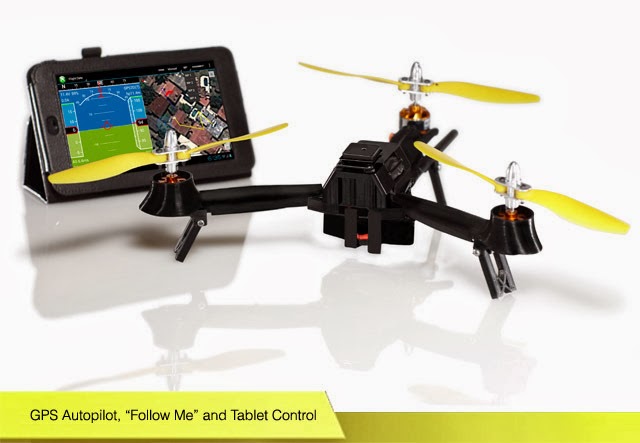
The Kickstarter-funded Pocket Drone is a foldable, flying "multicopter" that its creators dubbed "the GoPro of drones." It's equipped with an action camera for capturing aerial photos and video and a rechargeable battery allowing for flights of up to 20 minutes. Plus, the device folds up to the size of a small tablet for portability.

"Until now, most people could not participate in this awesome new technology revolution — the cost was too great, the drones too bulky, and the software too difficult to operate," creators Timothy Reuter, TJ Johnson and Chance Roth wrote on their Kickstarter page.

The creators claim that their drone is designed for easy use: It can be unpacked and launched within 20 seconds, and is controlled by an included remote, a third-party RC controller, or from any Android phone or tablet with a USB port. Additionally, the software is open source, so intrepid developers can add their own features.

The Kickstarter campaign presents the Pocket Drone as a relatively inexpensive tool for aerial photographers and videographers, as it's cheaper than your average DSLR camera. Backers can purchase a Pocket Drone for $445 without a controller, or $495 for the full package.

The Pocket Drone campaign finishes funding on March 9, and has already raised more than $300,000, far surpassing its goal of $35,000.

Image: Kickstarter

Read full Article…

Thursday, 16 January 2014

MeMini Is a Wearable Camera That Captures Moments After They Happen


Video can capture priceless moments — but not if you miss the shot.

meMINI is a wearable Wi-Fi-enabled camera with recall, which helps users save film-worthy moments in high-definition video after they've already come and gone.

Looping footage is captured every five seconds to five minutes. To permanently store the last recorded moment, users can press the recall button to transfer a file to cloud-based storage or the camera's internal memory. The meMINI can loop video for three continuous hours on a full charge.

What's more, users can attach the camera to their clothing via its magnetic back plates; this allows them to easily take it on the go.

An app compatible with iOS and Android can control the camera, the footage and how video is stored. It also lets users share moments they've recorded via email, social media or with the meMINI community.

meMINI co-developers Ben Bodley and Sam Lee are raising money for the device on Kickstarter. At press time, the device has already surpassed its original funding goal of $50,000.

"Technology changes—our memories should last forever," the camera's Kickstarter video explains. "Imagine if there was a device that captured our favorite moments that would otherwise be lost."

Image: MeMini

Read full Article…